Driver Options
Java.lang.ClassNotFoundException: oracle.jdbc.driver.OracleDriver. Just add the ojdbc14.jar to your classpath. The following are the steps that are given below to add ojdbc14.jar in eclipse: 1) Inside your project. 3) Right click on JRE System Library. 5) Select Configure Build Path. 6) Click on Add external JARs. This is an Oracle database driver for Rust based on ODPI-C. Applications using Rust-oracle 0.1.x should use 0.2.x. The incompatibility between 0.1.x and 0.2.x is trivial so they will work well without modification. The author continues updating 0.2.x to fix bugs as long as it doesn't introduce incompatibilities. The installation wizard creates an Oracle JDBC provider that uses the Oracle 10g JDBC driver (ojdbc14.jar). This JDBC driver can be used for connecting to both Oracle 10g and Oracle 11g. However, you might want to use the Oracle 11g JDBC driver (ojdbc5.jar) for connecting to Oracle 11g if you find issues with the Oracle 10g JDBC driver, or if your organization has standardized on the Oracle 11g JDBC driver.
- Devart ODBC Driver for Oracle provides high-performance and feature-rich connectivity solution for ODBC-based applications to access Oracle databases from Windows, Linux and Mac OS X, both 32-bit.
- Oracle - Please refer to Oracle’s website for instructions on how to download and setup their official driver: Oracle ODBC driver page. RStudio Professional Drivers - RStudio Server Pro, RStudio Connect, or Shiny Server Pro users can download and use RStudio Professional Drivers at no additional charge. These drivers include an ODBC connector for Oracle databases.

Connections to Oracle require the Oracle Instant Client to be installed.
Oracle - Please refer to Oracle’s website for instructions on how to download and setup their official driver: Oracle ODBC driver page
RStudio Professional Drivers - RStudio Server Pro, RStudio Connect, or Shiny Server Pro users can download and use RStudio Professional Drivers at no additional charge. These drivers include an ODBC connector for Oracle databases. RStudio delivers standards-based, supported, professional ODBC drivers. Use RStudio Professional Drivers when you run R or Shiny with your production systems. See the RStudio Professional Drivers for more information.
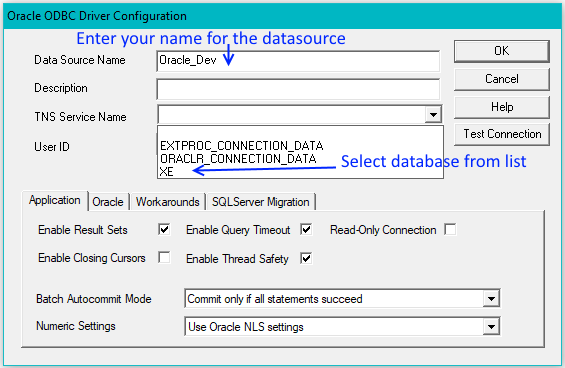
Package Options
There are packages that either connect via ODBC but do not provide support for DBI, or offer DBI support but connect via JDBC. The odbc package, in combination with a driver, satisfies both requirements.
Another package that provides both ODBC connectivity and DBI support is ROracle. The current version of dbplyr in CRAN does not yet fully support a connection coming from ROracle, but we are working on it.
Connection Settings
There are six settings needed to make a connection:
- Driver - See the Drivers section for more setup information
- Host - A network path to the database server
- SVC - The name of the schema
- UID - The user’s network ID or server local account
- PWD - The account’s password
- Port - Should be set to 1521
dplyr Translation
Known Issues
This section will be updated as new issues are found, and when fixes are applied in the development version of the dbplyr package. Drivers scientific data usb devices pc camera. The issue will be fully removed when the fix is part of of the package’s version in CRAN.
- RJDBC support - Even though it is not considered an issue, we have found a workaround. The approach is to point the current JDBC connection to the Oracle translation inside
dbplyr:
Please refer to the Issues section in dplyr to find out the latest regarding bugs and resolutions.
Important
This feature will be removed in a future version of Windows. Avoid using this feature in new development work, and plan to modify applications that currently use this feature. Instead, use the ODBC driver provided by Oracle.
You can control performance of the ODBC Driver for Oracle by knowing the data environment and correctly setting the parameters of the data source connection through the ODBC Data Source Administrator dialog box or through connect string parameters. The dialog box provides the following controls for connecting to a data source using the dialog box or using connect strings:
User DSN tab Lists the Data Source Names that are local to the computer.
System DSN tab Enables you to add or remove a system data source. System data sources can be accessed by all users on the local computer.
File DSN tab Enables you to add or remove a file data source from the local computer. File data sources can be shared by all users who have the same driver installed.
Drivers tab Lists the installed ODBC drivers.
Tracing tab Enables you to specify how the ODBC Driver Manager traces calls to ODBC functions. You can configure tracing separately for each installed ODBC application.
Connection Pooling tab Enables you to select connection options for each installed driver.
About tab Lists the installed ODBC component files.
Oracle Driver Installation
After you add a data source, you can use the ODBC Data Source Administrator dialog box to configure the access to your data source. Select a data source, and then click one of the tabs to edit or review the information.