When the IBM PS/2 was introduced, it included a motherboard mouse interface which was integrated with the keyboard controller (still called the PS/2 mouse interface long after the PS/2 brand was withdrawn); this fairly quickly drove the bus mouse design out of the marketplace. The bus mouse lived on in the NEC PC-98 family of personal computers. Necrostatin-1 (Nec-1) inhibits receptor-interacting protein 1 (RIP1) kinase and programmed necrosis. This study was designed to examine the protective effects and mechanisms of Nec-1 in concanavalin A- (ConA-) induced hepatitis in mice. C57BL/6 mice were exposed to ConA via tail vein injection and injected intraperitoneally with Nec-1 or vehicle. In order to determine the exact role of NETs in NEC pathogenesis, a protein arginine deiminase (PAD) inhibition model was established (preventing NETs formation in mice) by injecting BB-Cl-amidine once daily, starting on day one p.p. Additionally, human intestinal samples of diagnostically verified NEC were analyzed.
A Microsoft InPort bus mouse adapter, in the form of an 8-bit ISA (XT-bus) card. | |||
| Type | Computer mouse input port | ||
|---|---|---|---|
| Production history | |||
| Designer | Microsoft | ||
| Designed | late 1980s | ||
| Produced | 1980s to 2000 | ||
| Superseded by | PS/2 port, USB (2000; 21 years ago) | ||
| General specifications | |||
| External | Yes | ||
| Cable | 9 wires plus shield | ||
| Pins | 9 | ||
| Connector | Mini-DIN-9 | ||
| Data | |||
| Data signal | 30–200 Hz (interrupt mode) with 3 button state signals and quadrature signals for mouse movement | ||
| Pin out | |||
| Female port pin layout from the front | |||
| Pin 1 | SW2 | Mouse button 2 | |
| Pin 2 | SW3 | Mouse button 3 | |
| Pin 3 | GND | Ground | |
| Pin 4 | XB | X position | |
| Pin 5 | YA | Y position | |
| Pin 6 | YB | Y position | |
| Pin 7 | SW1 | Mouse button 1 | |
| Pin 8 | Vcc | +5 V Power | |
| Pin 9 | XA | X position | |
| XA/XB and YA/YB indicate movement and direction based on quadrature phase. | |||
A bus mouse is a variety of PCcomputer mouse which is attached to the computer using a specialized interface (originally, the Microsoft InPort interface developed for Microsoft's original mouse product).
In the late 1980s, mice were not integrated with IBM-compatible personal computers, and the specialized bus interface (implemented via an ISA add-in card) was one of two popular ways to connect a mouse. (Serial interfaces, common on engineering workstations, were the other method.) When the IBM PS/2 was introduced, it included a motherboard mouse interface which was integrated with the keyboard controller (still called the PS/2 mouse interface long after the PS/2 brand was withdrawn); this fairly quickly drove the bus mouse design out of the marketplace.
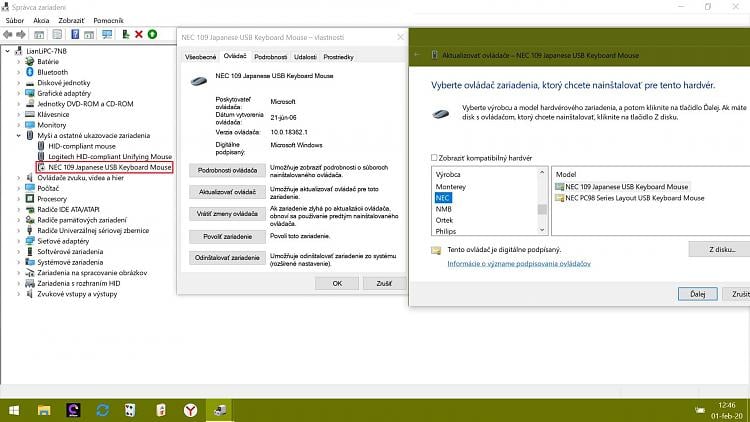
The bus mouse lived on in the NEC PC-98 family of personal computers in Japan. Ptytrade USB devices Driver Download for windows.
See also[edit]
Further reading[edit]
- Paul, Matthias R. (2002-04-06). 'Re: [fd-dev] ANNOUNCE: CuteMouse 2.0 alpha 1'. freedos-dev. Archived from the original on 2020-02-07. Retrieved 2020-02-07.
[…] The original Mouse Systems Bus Mouse is a normal serial 8250 compatible mouse using the normal Mouse Systems serial protocol, however the base address of this 8250 type chip is not one of the usual COM port addresses 3F8h, 2F8h, 3E8h, or 2E8h, but either 238h or 338h. Besides others these addresses are also supported as alternative addresses for serial ports on the German c't UniRAM add-on ISA card. […] Bus mice from other vendors use completely different interfaces, partially residing at the same I/O addresses […]
External links[edit]
Nec Mice & Touchpads Driver Download For Windows 7
- 'Mouse Connector'. Archived from the original on 2010-07-31. Retrieved 2006-10-27.
A Microsoft InPort bus mouse adapter, in the form of an 8-bit ISA (XT-bus) card. | |||
| Type | Computer mouse input port | ||
|---|---|---|---|
| Production history | |||
| Designer | Microsoft | ||
| Designed | late 1980s | ||
| Produced | 1980s to 2000 | ||
| Superseded by | PS/2 port, USB (2000; 21 years ago) | ||
| General specifications | |||
| External | Yes | ||
| Cable | 9 wires plus shield | ||
| Pins | 9 | ||
| Connector | Mini-DIN-9 | ||
| Data | |||
| Data signal | 30–200 Hz (interrupt mode) with 3 button state signals and quadrature signals for mouse movement | ||
| Pin out | |||
| Female port pin layout from the front | |||
| Pin 1 | SW2 | Mouse button 2 | |
| Pin 2 | SW3 | Mouse button 3 | |
| Pin 3 | GND | Ground | |
| Pin 4 | XB | X position | |
| Pin 5 | YA | Y position | |
| Pin 6 | YB | Y position | |
| Pin 7 | SW1 | Mouse button 1 | |
| Pin 8 | Vcc | +5 V Power | |
| Pin 9 | XA | X position | |
| XA/XB and YA/YB indicate movement and direction based on quadrature phase. | |||
A bus mouse is a variety of PCcomputer mouse which is attached to the computer using a specialized interface (originally, the Microsoft InPort interface developed for Microsoft's original mouse product).
NEC Mice & Touchpads Driver Download For Windows
In the late 1980s, mice were not integrated with IBM-compatible personal computers, and the specialized bus interface (implemented via an ISA add-in card) was one of two popular ways to connect a mouse. (Serial interfaces, common on engineering workstations, were the other method.) When the IBM PS/2 was introduced, it included a motherboard mouse interface which was integrated with the keyboard controller (still called the PS/2 mouse interface long after the PS/2 brand was withdrawn); this fairly quickly drove the bus mouse design out of the marketplace. Omron plc driver download.
Nec Mice & Touchpads Driver Download For Windows 10
The bus mouse lived on in the NEC PC-98 family of personal computers in Japan.
See also[edit]
Further reading[edit]
- Paul, Matthias R. (2002-04-06). 'Re: [fd-dev] ANNOUNCE: CuteMouse 2.0 alpha 1'. freedos-dev. Archived from the original on 2020-02-07. Retrieved 2020-02-07.
[…] The original Mouse Systems Bus Mouse is a normal serial 8250 compatible mouse using the normal Mouse Systems serial protocol, however the base address of this 8250 type chip is not one of the usual COM port addresses 3F8h, 2F8h, 3E8h, or 2E8h, but either 238h or 338h. Besides others these addresses are also supported as alternative addresses for serial ports on the German c't UniRAM add-on ISA card. […] Bus mice from other vendors use completely different interfaces, partially residing at the same I/O addresses […]
External links[edit]
- 'Mouse Connector'. Archived from the original on 2010-07-31. Retrieved 2006-10-27.